PIS/COFINS credit recovery in Brazil is a five-year retroactive audit across three independent legal theses. Reaver audits the raw filings, calculates the credit per thesis, applies Selic correction, and formalizes the claim.
- Client
- Tax practices and in-house tax teams (Brazil)
- Industry
- Tax · Legal services
- Problem
- Manual PIS/COFINS credit recovery: months per client, error-prone
- Solution
- Document-grounded recovery agent: audit, calculate, formalize
- Stack
- XML/EFD ingestion · rules engine per tax regime · Selic correction · claim generation
- Live at
- turing.com.br/produto-reaver
Brazilian companies routinely overpay federal PIS/COFINS taxes, and the law lets them recover five years of it. The recovery is not a form. It is a retroactive audit built on three independent legal theses (exclusion of ICMS from the tax base, input credits, single-phase/ST products), each with its own base, rate, and eligibility depending on the company's tax regime.
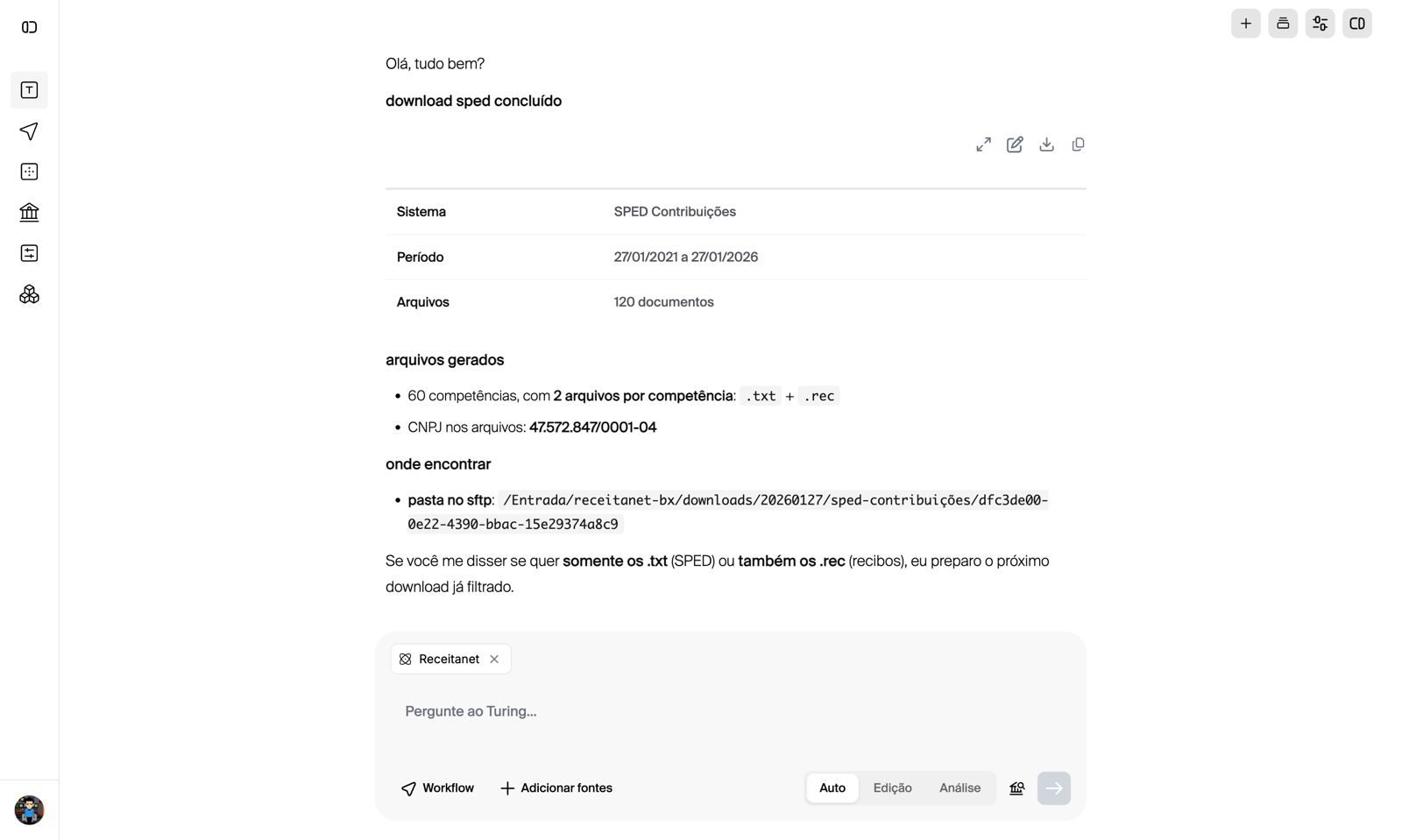
The evidence is raw: thousands of invoice XMLs and sixty months of EFD-Contribuições filings. A firm does the work by hand: export the filings, rebuild the ledger in a spreadsheet, apply the thesis, compute statutory interest from each payment date, then formalize the claim with the tax authority. It takes months per client. Errors compound quietly, and a wrong claim invites an audit.
Most firms therefore only pursue the largest clients. The long tail of recoverable credit goes unclaimed.
- A calculation grounded in the actual filings, not an estimate from revenue
- Regime-aware logic: Lucro Real, Lucro Presumido, and Simples each behave differently
- Full traceability: every credit must point back to the filing line that supports it
- Correct Selic correction from each original payment date
- Output the tax authority accepts, not a spreadsheet a human still has to rewrite
- Cut recovery time per client from months to hours
- Make the long tail economical: recovery viable beyond only the largest clients
- 01
Phase 1: Encode the theses
Before any model, the three theses were written as rules with explicit inputs and eligibility conditions per regime. This is the part that cannot be “prompted.”
- 02
Phase 2: Ingestion
Parsers for invoice XMLs and EFD-Contribuições, normalizing sixty months of filings into a single ledger with payment dates preserved.
- 03
Phase 3: Classification and calculation
Each ledger line is classified against the applicable thesis; credits are calculated per period and corrected by Selic from the payment date. Every output line carries its source reference.
- 04
Phase 4: Formalization
The agent produces the claim package in the format the authority expects, plus a reviewer-facing reconciliation view.
- Recovery cycle: months → hours
- Firms can now quote the recovery upfront using the same engine. The public calculator on the product page runs on it.